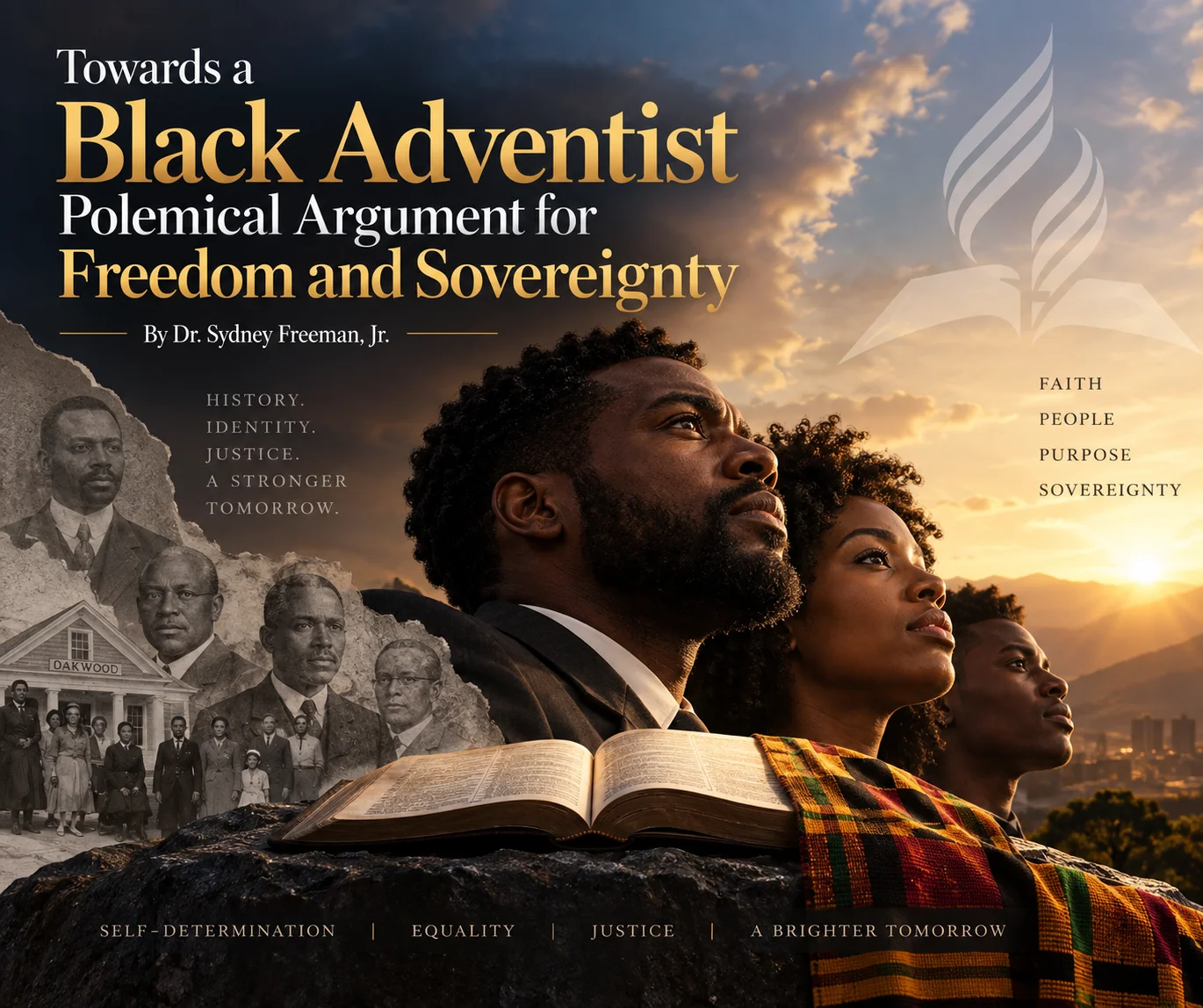
While the Seventh-day Adventist church has historically championed racial and ethnic equality. It has had a checkered past regarding meeting that standard. Whether it has been the lack of support of Jews in Nazi Germany, taking sides in the ethnic cleansings between Tutsi and Hutus in Rwanda, or segregating African Americans from eating in the General Conference cafeteria. Adventism has not always represented the abolitionist spirit it was once founded upon.
Today there are some Black Adventists who have asked why Adventism with its claim of "Present Truth" doesn't speak more loudly and forthrightly regarding anti-Black racism that continues to perpetuate itself today, particularly in North America and Europe. And if this is the case, why doesn't Black Adventist leadership and laypersons push for greater autonomy and self-governance similar to historically Black denominations based in the United States. One reason might be the lack of a clear and actualized 21st century Black Adventist Polemic. For the sake of this writing, I define such a polemic as a strong argument and explicit apologetic for self-determination and sovereignty of Black people.
History of Black Adventism in North America
While not named as such, Black Adventism over time has wrestled with what self-determination looked like in North America. For instance, in the late 1800s leaders such as Charles M. Kinny, affectionately described as the founder of Black Adventism, fought for an integrationist approach.
The experiences of early twentieth-century Black Adventist leaders such as Lewis C. Sheafe, John W. Manns, and James K. Humphrey suggest that integration alone was insufficient. Although they initially pursued greater inclusion within existing denominational structures, they later recognized that Black self-determination provided a more viable strategy for advancing Black Adventist interests.
From the late 1800s to the 1950s the Black work established Oakwood Industrial School in 1896, the Negro Department in 1909, and Regional Conferences in 1944. While all of these entities were started or eventually led by Black Adventist leaders, each entity reported to and was/is ultimately governed by the General Conference of Seventh-day Adventist, which consisted of predominantly white leadership.
So, while Black Adventists have had major flash points such as the Lucy Byard incident and James K. Humphrey leaving the church. Very few times have Black Adventists challenged the integrationist ideal besides members of the Free SDA Movement, the United Sabbath-day Adventists, and the Seventh-day Christian Conference.
Most Black Adventist in North America have accepted a polemic of self-determination within a broader integrationist frame. Instead of seeking sovereign self-determinist positions as other Black-led movements who became their own denominations such as the National Baptist Convention, USA, the Church of God in Christ (COGIC), and the African Methodist Episcopal Church (AME). We have tried to work with the broader Adventist system while creating a power base through the advancement of Regional Conferences and Black ministerial representation throughout the world church.
Location and Culture Shape Practice
Location and culture often shape how communities' express self-determination. Black churches do not emerge in a cultural vacuum. Rather, they are influenced by the historical, political, social, and cultural contexts in which they develop. Consequently, expressions of Black identity and liberation are not always manifested in the same ways across geographic regions.
For example, one might observe differences between historically Black churches in Atlanta and Chicago in their overt displays and celebrations of Blackness. Many Black churches in the Atlanta metropolitan area that are deeply committed to racial justice and Black advancement often maintain worship spaces with relatively few visible symbols connecting congregants to Africa or the broader African diaspora. In contrast, some historically Black churches in Chicago incorporate more explicit expressions of Africanity through artwork, liturgical furnishings, iconography, and other visual symbols (i.e., St. Sabina Catholic Church and Trinity United Church of Christ). Neither approach should be interpreted as more authentically Black than the other. Rather, these differences illustrate how local histories and cultural environments shape the visible expression of Black identity and self-determination.
A similar pattern may be observed within Black Adventism. The theological, cultural, and historical development of the Black Adventist church has influenced how Black identity is expressed within its congregations. Historically, Black Adventism has often emphasized institution-building, education, evangelism, leadership development, and community service as primary expressions of empowerment and liberation. As a result, Black Adventist congregations have generally been less likely to communicate Black identity through overt cultural symbols and more likely to express it through organizational structures and mission.
It is noteworthy that the Regional Conference movement was formally organized in Chicago rather than in Atlanta or at Oakwood Junior College (now University) in Huntsville, Alabama. While this fact alone does not establish causation, it raises an important question: To what extent do geography and culture influence how Black Adventists conceptualize and enact self-determination? The emergence of Regional Conferences within a city profoundly shaped by the Great Migration and traditions of Black institutional autonomy may suggest that place matters in the development of liberation-oriented ecclesial movements.
Where Do We Find Ourselves Now
Over the years many Black Adventist have struggled with the lack of response by the Adventist church to the challenges that Black Americans face. There have even been sharp criticisms of the Black leaders within the church regarding their responses to such issues. While there have been notable Black Adventist leaders such as E.E Cleveland, Calvin Rock, etc. who have sought to publicly and intentionally address issues of anti-Blackness within and outside of the church. The church at-large has not always met the mark of speaking truth to power when it comes to combating racism and in particular anti-Blackness.
Currently, there remains issues such as the lack of representation of Black Americans in General Conference leadership; the lack of inclusion of Black Americans who participated in the 2025 General Conference Session; and prominent Adventist denominational and thought leaders continue to support those who expose anti-Black rhetoric such as the late Charlie Kirk. These and other challenges have caused me to ponder why this remains such an issue within the church. One answer might be a practiced Adventist theological perspective that doesn't center racial justice and equity. I believe that a 21st century Black Adventist Polemic should be developed to strengthen the Black Adventist church and affirms our dignity, self-identity, and sovereignty.
Such a polemic sends a strong signal to the Black Adventist believers that we are loved, valued, and honored by God. When put into demonstrated practice it will provide tangible evidence that Black Adventist leadership takes seriously the psychological and spiritual harm poised by a broader church that does not celebrate and honor its Black members.
Where Do We Go from Here
Black Adventist Theologians along with ministers should work together to develop a practical theological polemic that can be implemented at the local church level that reaffirms the value of their Black members. Biblical precedence for such a polemic can be found in scripture. Think of examples related to Moses (Exodus 3:7-10) when seeking freedom from unjust systems; Paul (2 Corinthians 8:13-15) advocating for economic fairness; and Jesus (Luke:18-19) when he declares the relief of the oppressed.
We may need to acknowledge that church leaders may often choose a freeish approach (partial freedom and liberation) over self-determination and sovereign approach. It could be suspected that this is because of the precedence of backlash towards Black institutional leaders when they have attempted to push for sovereign initiatives. They have been undermined and reprimanded by the church. Leading to a loss of influence both among the Black work and the broader church. For instance, former Regional Conference presidents such as Charles Joseph from Lake Region and Joseph McCoy from South Central Conferences both fought for initiatives that empowered Black Adventism and paid significantly professionally as a result.
I am arguing that Black Adventism must develop a polemic that is both Christ-centered and culturally responsive to the needs of Black congregants and the broader Black community. Doing so requires Black denominational leaders to make a fundamental choice: to prioritize Black self-authorship over professional mobility within the existing denominational structure. The challenge before Black Adventism is whether it will continue to seek legitimacy through proximity to white institutional power or pursue a model rooted in Black self-determination and autonomy. The goal is to shift from seeking a symbolic seat at someone else's table to strengthening our existing tables institutions (i.e., Regional Conferences, Message Magazine, Oakwood University, Pine Forge Academy, Breath of Life Ministries) capable of advancing Black empowerment and transforming the material conditions of our communities.
Perhaps such a polemic will challenge us to ask the same question Black Adventist leaders confronted nearly a century ago: Is meaningful Black empowerment possible within existing structures, or does genuine self-determination require a more sovereign approach, as James K. Humphrey, the Free Seventh-day Adventist Movement, the United Sabbath-day Adventists, and the Seventh-day Christian Conference ultimately determined?